mercoledì 4 dicembre 2019

1940s cotton dress with long sleeves (Butterick 6485)

Another dress made using the same Butterick pattern I previously used this summer to make my first retrò creation ever. Going towards the late autumn/early winter I was looking for a long sleeved dress so I gave this pattern another chance since I really wanted to try out the long sleeves option. I grabbed some green cotton from stash and with some wise pattern placement I was able to cut my brand new dress using a veeeeery limited amount of fabric, which this time was long enough to use the full length of the skirt pieces. Alas the sleeves turned out a little bit shorter than I expected but it's not a big issue since I would have used gloves to fill the gap.

As with the other dress, the instructions were absolutely easy to follow and being my second time with this pattern I didn't read them. The hem is approx 5 cm wide to add weight and structure.

To complete my seasonal look I decided to use true vintage accessories from my closet, including a new (modern) pair of seamed stockings. I have a problem with nylon stockings/tights and so on because I find them incredibly uncomfortable (how can you wear them everyday? Lucky you!) so I suffered a little to take these shots but the result was really worthy.

The only difference with the other dress as you can see is the sleeve option, the skirt length and the zipper placement, which here is on the left side and not on the back (big mistake...you really need  that opening to wear the dress so don't skip the back zipper or your head won't pass - I had to make my neckline much lower to allow it). The rest was made exactly as the summer version.


I'm very happy with autumnal look and I can't wait to make another version of this dress, this time using another great feature of the pattern: the changeable front/shoulder pieces! They can be made in different colours to allow a multiple combinations of styles and, why not, to use small remnants of fabric we have at home. Stay tuned! 

venerdì 1 novembre 2019

A 1860s purple skirt and bolero

When it can not be made in black, it has to be purple!


Alas my antique 1850s parasol didn't come on time and had to use this one ... 


This costume has a long story. It was originally planned for last year but you know, I can hardly respect my own schedule regarding personal project. So I waited. And waited. I started a fitted bodice last spring (see photos below) but never had the chance to finish it due to lack of time and precocious heat waves; the cotton used for this project is kinda thick and it can't be in the middle of the summer without literally melting in it, including all the undergarments and the false sleeves. 


But when we decided to reenact 1860s in Marlia last September I immediately realized I had to work on this piece again. I needed something lightweight but also easy and quick to make. The challenge was not impossible at all but the deadline was approaching fast. I mean, the skirt was already cut and serged, the facing was already prepared, the trim was already in stock and I had an almost brand new Garibaldi blouse in my wardrobe used just for a couple of shots. So why not making a new, matching bolero?

I already made a 1860s bolero with pagoda sleeves earlier this winter but in bright red, definitely not the best combo for a purple skirt. I had some leftovers in stash of purple cotton, enough to make a sleeveless bolero (remember what I said before about heat waves? Well, we had another one in mid September, just some days before leaving for Tuscany...). I decided to use only materials from stash to save money and time (there was no time at all to order materials online and wait for them to be delivered...) and went for a vintage trim to decorate the jacket, the same I used for the red one. Not the best choice but at least it worked. I went for a geometric design, the best I could achieve with that kind of trim. Something tells me it will be remade very soon after the event... 


The bolero came together really fast, just in a day or 2. It is lined in cotton and with piping around neckline and lower edges of sleeves. It's worn over a Garibaldi blouse and a black cotton swiss waist. The skirt was also made quickly. Most of the time was spent pleating and attaching the waistband. I made this skirt to have a typical 1860s look with fewer pleats at front and much volume at the back; I do not have an elliptical crinoline so it has the same width and length all around. It has pleats facing at upper edge, hem facing at bottom and a side closure. 


The hat is a simple wool brimless hat with a silk muslin veil on top. Gloves and brooch are antique pieces while the earrings are by dear The Lady Detalle on Etsy. 

The weather during the day became too hot to wear the bolero so ta-dah! It was time to take it off and show the world my swiss waist! 


The Swiss Waist was fashionable accessory worn by women to enhance the small waist and add interest to very simple garments like blouse and skirt. Mine was made after a pattern in  "The Victorian Dressmaker book" by Prior Attire. I used some black cottons from stash, some crochet trim and eyelets at the back. It truly makes the difference and I felt really stylish.   

But look at the amazing pics I got with it! 


And that's all for now! Of course I will try to finish the fitted bodice before next heat waves... maybe for Christmas? :) 

A corded petticoat (1830s/1850s)

What is exactly a corded petticoat?
I'm sure you already came across this therm in your costuming journey. Before the invention of the cage crinoline, the fashionable bell shape was achieved wearing multiple layers of petticoats. With  multiple, I mean a lot. Of course all these layers needed a foundation garment to support the weight: the corded petticoat.


Some extant examples...

An original petticoat from MET museum


Los Angeles County Museum of Art

Corded petticoat from 1850s 


Made of several rows of cording, the petticoat helped to support the weight of all those skirts needed to achieve the desired silhouette. The position, dimension, layout of the cording could vary, as well the length of the petticoat itself. There are examples of shorter petticoats, and some were corded only at the bottom. There are two ways to make a corded petticoat.

Method 1: two layers of fabric (cotton or linen) and the cording sandwiched in between (you can use a zipper foot on your machine or a regular one, as I did)

Method 2: corded tucks, the way I chose, keeping in mine that every tuck will make your petticoat shorter so a little bit of math will be involved. Tucks will also add weight to the petticoat.

After this, you can pleat of gather the upper part of the petti before adding the waistband.

My CP in the making... of course over a non Victorian dress. 

Corded petticoats may sound intimidating but they're not. They require time, yes, but I find them lovely to make. They're not something you can do a day before your event. Plan ahead. Plus they also need to be starched but I will talk about this step later.

After the corded petticoat, the standard petticoat comes next. Lot of variations here: plain, tucked, with ruffles or frills, in linen, cotton or silk. I chose to make one in cotton lawn from stash, using several tucks to add weight and reduce waste. My fabric was very long (140 cm) and since I already knew I would have never used the leftovers, I decided to use the full length using tucks. I ended with a petticoat of 93 cm approx without losing a cm and zero waste. So historical accurate after all!
After finishing the petticoat, I gathered the upper edge and added a waistband.

Of course Tiffany had to join. 


Now the fun part: starching! Starching is an essential step when making Romantic and Early Victorian era undergarments. Starch gives strength and helps to keep the garment itself clean, asking for less frequent washing. Also here there are several ways to make or use starch:

Premade starch: chemical, but will save you some time
Homemade starch: natural, made of rice, corn, potatoes.


The starched standard petticoat. 


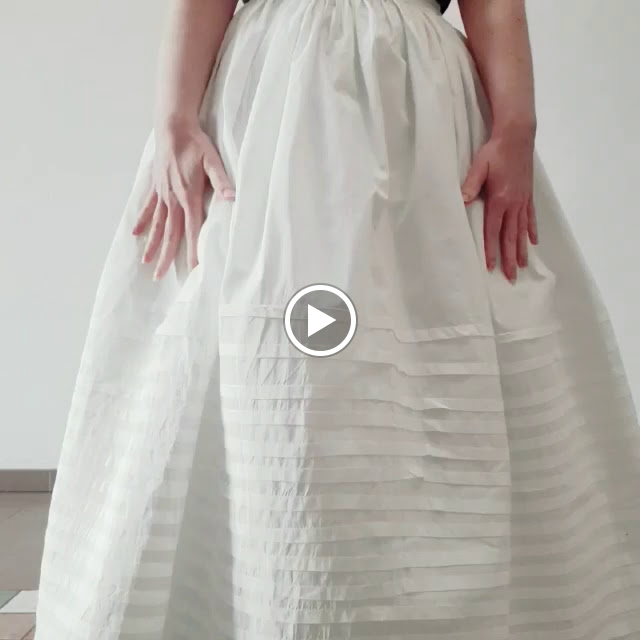
In every case you need to boil your water and soak your undergarments in a bowl, letting them to dry outside. Once damp or fully dried, iron it and see the magic happen: the starch will give a "paper effect" to your petticoats, which will make an incredibly lovely sound when moving! Check the videos below:


venerdì 30 agosto 2019

1940s purple cotton dress

Back on the blog with some exciting things to talk about! My last entry has been in May and many projects developed since then. I'm not going to talk about them in chronological order. 

Let's start! 

I'm very, very excited about this one. It has been a work of research, growing passion and vintage shopping. It took me weeks (or months) to collect all the accessories for this project - you know, pattern and fabrics often come last. I always loved WW2 fashion but never thought I would have been interested in making, or wearing, a dress from that decade. Too modern for my tastes as I didn't consider post-WW1 fashion with a critique eye for ages. 
Then, growing up, some things started to change. I decided to try vintage styles for the first time and it has been amazing! During 40s women were more active, worked, left the house more often and their dresses had to be practical but also feminine (the androgynous figure of the 20s was no longer in fashion...) and this afflicted the way clothing was designed. The 40s woman has a hourglass figure with square shoulders given by shoulder pads, A- line knee-length skirts, medium-long hair and make up. Something I could relate to. 


To make my dress I decided to use materials from stash. Being my first attempt at a vintage design I didn't want to invest money in fabrics. I didn't know how I could look with a dress from that era, plus my stash really needs to be cleaned. I had some remnants of purple cotton which were enough for the dress, alas in a shorter length. I don't have what you can call beautiful legs and I don't like to show my knees but I couldn't do otherwise. Also, the dress called for a back zipper... exposed. Omg. 


The construction was really straightforward and the dress came together in just two days (you can read my detailed review here), including hemming and attaching the zipper by hand. Yes. By hand, using a prick stitch as in 18th century gowns. The sweetheart neckline pulls a little due to the weight of the interfacing but it's not a problem. 
I wore it over a slip and modern underwear as I'm not going to reenact with it. 


Now the best part, the accessories! 
The veil is authentic italian vintage and I absolutely love how it falls. The spots are very wide and may hurt the sight after a long time but if worn by the hour it's truly acceptable. The straw hat also comes from an italian vintage market, same the brooch. The gloves are vintage (unsure about their real age) and were purchased from abroad at a very ridiculous price. Also the hair net comes from the UK and it saved my look since my hair are too long to be styled in 1940s style. 
Now the best pieces. The bag is original from the 40s and was found in a market while looking for vintage/used lace veils! The suitcase was found in a corner of a thrift shop for just 2€. The external surface has scratches but inside it's immaculate. The shoes were found at the same market. They fit perfectly but I didn't realize the bottom part of the heels was damaged and needed to be replaced (this costed me more than the shoes themselves...)  


And that's all! I'm very pleased with this project. The pattern is very versatile I already made another version from it with longer sleeves. 

lunedì 13 maggio 2019

Edwardian jumper dress and tucked blouse (1900-1905)

Finally I can talk about this dress! Before we start, I have to add I didn't draft it by my own but I used a gorgeous pattern by Black Snail Patterns for both dress and blouse; I was out of time to draft a new dress and blouse by myself so I cheated, using the pattern as guide for the main pieces and making my own alterations. 
The dress shown in the pattern is very similar to the afternoon dress I planned to make for Venice and shown in PoF 2 by Janet Arnold. Alas, I spent too much time on my 1840s tartan dress and had a very little time to make another frock before leaving. I already had fabric and trim in stash so I could start the work on the dress very quickly; the description says it's a jumper dress, an informal garment worn in summer time with a simple shape, worn over a blouse and a belt. Due to its loose shape it doesn't require a corset so it was perfect for the long and hard day in Venice. Wearing a corset for the whole day was out of question. I wanted to live the day as much as I could without feeling restricted in my Edwardian corset. A simple boned belt would have worked perfectly, and it did. 
The dress is worn over my usual Edwardian layers (petticoat, ruffled corset cover ecc ecc) minus the corset. 
In the following pics I'm wearing a vintage fur, an antique brooch and parasol, vintage gloves and a self made new hat, covered in black cotton and with a vintage birdcage veil.


The construction was really simple. No lining required so measure carefully before cutting your fashion fabric: there's no room for error! The bodice went together really easily: the sleeves and collar have a self facing, the bottom is gathered to get the "pigeon breast" of the era and attached to a waistband. I changed the way the skirt is pleated. The pattern calls for box pleating and top stitching, which I disliked. I moved all the pleats to the back to have smooth hips and volume in my derriere. I also used snaps instead of buttons and buttonholes to close the bodice because I didn't want to get crazy with buttonholes (I don't find sleeves hard as many costumers out there but I find buttonholes really frustrating!!). The skirt and the waistband close with hooks over a placket. Hem, sleeves and collar were trimmed in black to hide the top stitching. That's all.
The pigeon breast is obtained once the dress is on, using the belt as a firm base to hold the gathers in place. 


Before making the dress of course I made the blouse. Very easy construction here as well, if you already know how to make an Edwardian blouse and tucks you're half done. The pattern calls for chest tucks, collar tucks and sleeve ruffle tucks and the chest ones need to be self drafted using the guidelines included in pattern instructions. It took a while but nothing endless. I omitted the lace insertions since there was no time at all. The sleeves have an inner tape to be fitted at the elbow. I find them a little bit long for my arms so next time I will make them shorter. The rest was absolutely perfect, as it was drafted for me! Forgot to mention I used a size 12 for both blouse and dress. 


The blouse looks absolutely gorgeous also without the dress, paired with a simple skirt as I did for this photoshoot. 


Post in evidenza

Edwardian skirt and blouse, circa 1900-1905

I've always been fascinated by the style of early Edwardian era, with those lightweight blouses, fabrics, delicate laces and floating s...