Visualizzazione post con etichetta rievocazione. Mostra tutti i post

lunedì 11 dicembre 2017

Making a 1890s black outfit, part 1

Hi everyone! The holiday season has started and so this means I have some spare time to work on my personal projects. This time I'd like to introduce my 1890s black outfit. I'm new to late Victorian costuming (oh well, let's say I explored very few of it) and let's say I'm not a fan of those huge sleeves. After looking at some extant examples I saw huge sleeves last

ed for a very short time and not every 1890s bodice had leg-o'-mutton sleeves so I decided to give this era a try. I found some beautiful examples of black dresses not stricky mourning and went ahead with that idea.


Both there dresses are beautiful and I love Cléo de Mérode hairstyle!

So, after checking the web for resources I decided my dress would have been in black cotton sateen with very minimal embellishments. 

Before starting to work on the skirt I worked on the undergarments. I took and old Edwardian petticoat from my closet and restyled it, sergin' again seams and adding a lovely ruffle at the bottom to help the skirt in keeping its shape at the bottom. Luckily I already had corset and chemise (no combinations yet alas!) so this part came together really quickly. 


Then I started to work on the skirt. I drafted a pattern by my own looking at some period layouts. It's really simple, trust me. All you have to do is to measure yourself carefully at waist, centre front and back if you want a train. Divide your waist measurements by 7 (the number of gores, since the front is cut on fold) and draft your pattern; the back and side back have to be more generous in size to end up with the pleats. 
Gored skirts ended in with very large pleats at the back to create the "fan" look and that's what I did. The front is straight all around my hips. My skirt is high waisted to use the waistband as belt. I have very large hips and  I have to say this skirt is incredibly comfortable, smoothing my curves and making my belly look really flat. AH! 


I wanted my skirt to be light, to be worn in summertime as well so it's not lined or flat lined. The hem is reinforced with some black bias tape 25 mm wide faced inwards. 
The back of the skirt closes with hook&eyes and two pair of snaps (they're HA, did you know? They were invented in the 1880s!) mounted over the placket. Unfortunately my waistband ended to be too large so it overlaps too much but it can be easily fixed in a second moment. 

When I was done with the skirt I hand sewn some yards of beautiful vintage velvet trim all around the hem as decoration. It's so lovely! 


Now the fun part: bodice and sleeves! 

venerdì 2 giugno 2017

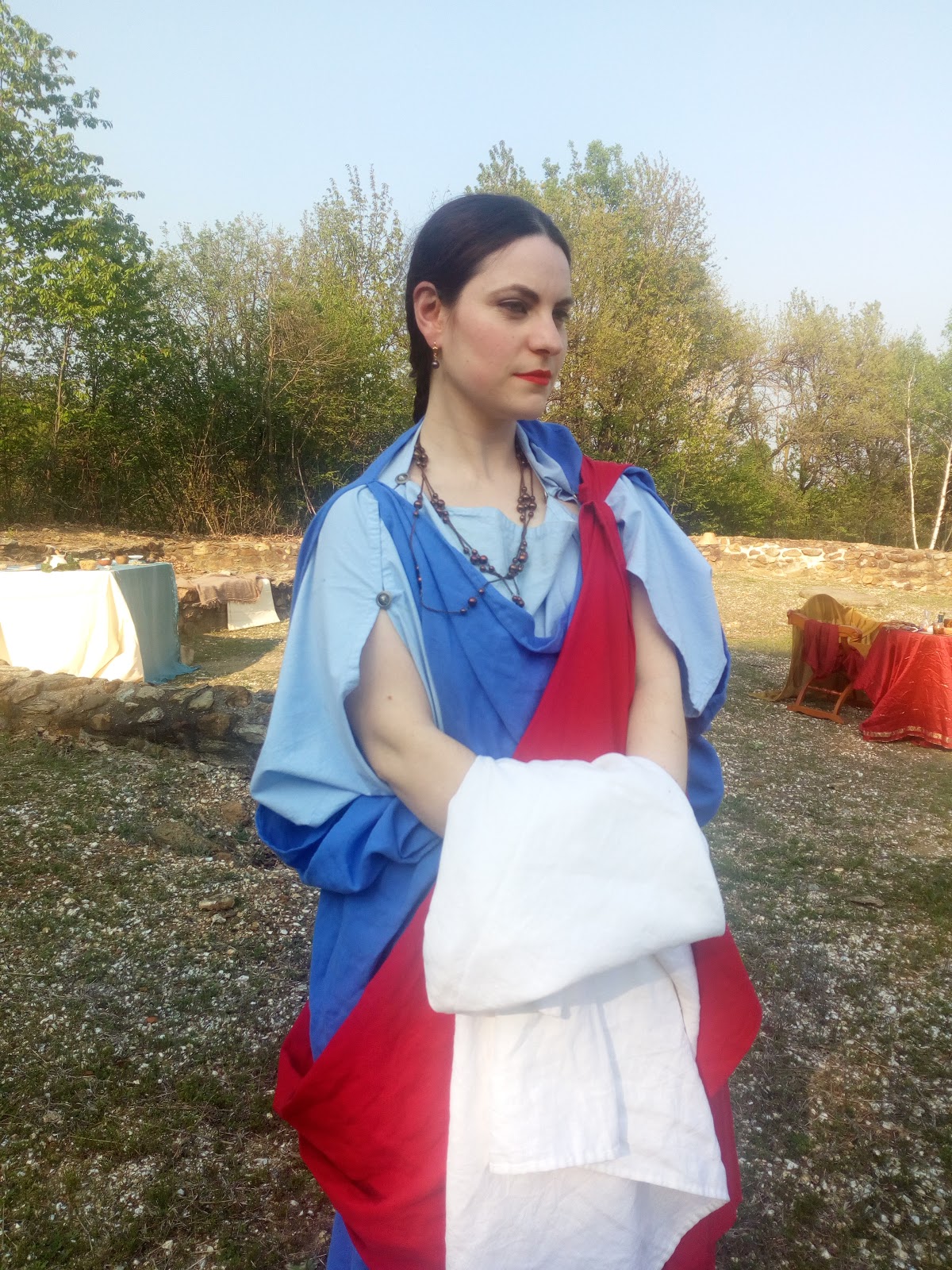
New Ancient Roman stola and veil in linen

It's been a while since I updated  this outfit, I admit. Things are getting really busy here, including a big new: we're moving in a bigger flat! So this means we're surrounded by boxes everywhere worse than usual (lol), displaced furniture and so on. The shop is still running though it's really hard to combine work and moving. Anyway, we decided to celebrate this moment introducing a new discount code which gives you the opportunity to get free shipping on every order above 100€!

Let's talk about the dress now. Last April we introduced the Roman world in our events since some of us already had experiences in this field. I was planning an update version of my outfit from a long time and this event was the best occasion to sew a stola and a veil.

Some costume history...
The stola was an outer layer worn by married women to indicate their status; it was usually sleeves and come from a rectangle of fabric draped on shoulders and secured with brooches or pins. The veil was worn over the head by every woman when she was outdoors (sounds
familiar, uh?) and could be replaced by the larger and longer palla.

So I just had to make a stola and a veil, nothing difficult. The stola  is made of lightweight blue linen with handsewn finishing and same for the veil, which is white. The day was very hot and sunny and I'm so happy to have worn the veil on my head.


And the stola...


The red palla and the under tunic were already part of the outfit. I'm sorry for the lack of hairstyle but I was waiting for  my turn to be brushed ;) 

And that's all for now! I didn't take more photos that day but I'll use this outfit again next September!


domenica 21 maggio 2017

An 18th century day in the gardens of Stupinigi...

Last week we are asked to set our event in the beautiful gardens of Stupinigi. The weather was warm and windy, a delight if compared to the heavy rainy days we had in the middle of the week. This was not a didactic event as we usually do, but a living history one without interaction with the public (except some photos or questions when we left the gardens). 
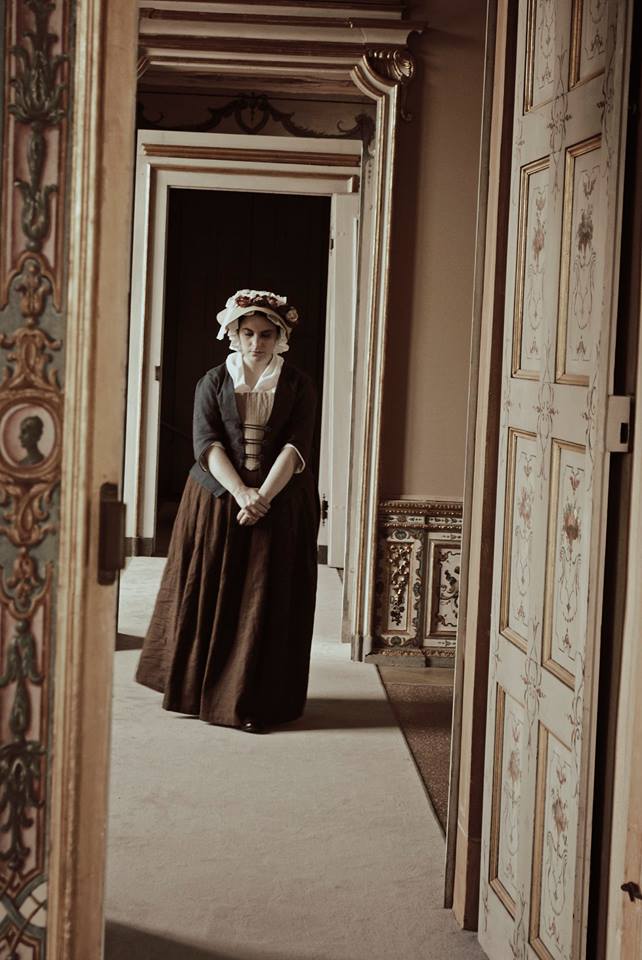
I wore again my lower class outfit which is indeed brand new, and brought with me some sewing and embroidery tools. My new housewife kit I got from Nehelenia Patterns worked great for the day! It's an essential kit filled with essential tools like period scissors, needles, pins, wooden thimble and a couple of buttons; I added my wax, thread wand and embroidery scissors and the kit was completed. 

I'm so glad I chose to wear the cap and the straw hat  in the afternoon. The sun was really strong. 


All photos by Stefania Gusatto.

The new outfit worked great outdoors (in the previous event we were indoors) and the linen helped me in stay warm but not hot. It's definitely not a summer garment because the wave of the linen of the jacket is kinda heavy but for the spring is ok thanks to the cotton lining; the skirt was worn over a cotton petticoat and a large bum pad. The whole thing is worn over chemise and my white fully boned stays I made last year from Norah Waugh "Corsets and Crinolines". I will need a new pair of stays soon since this one has become too large and the ends meet in the back. Le sigh. I worn this only once! The stomacher is then pinned in place to the corset and the fichu is tucked underneath. 

Some other photos...


And yeah, we also acted for an incoming historical documentary!


And, as usual, we took a short video with the costume on: 


Don't forget to visit our page Le Vie del Tempo, we're also on Instagram! 

martedì 7 marzo 2017

A Regency crossover gown

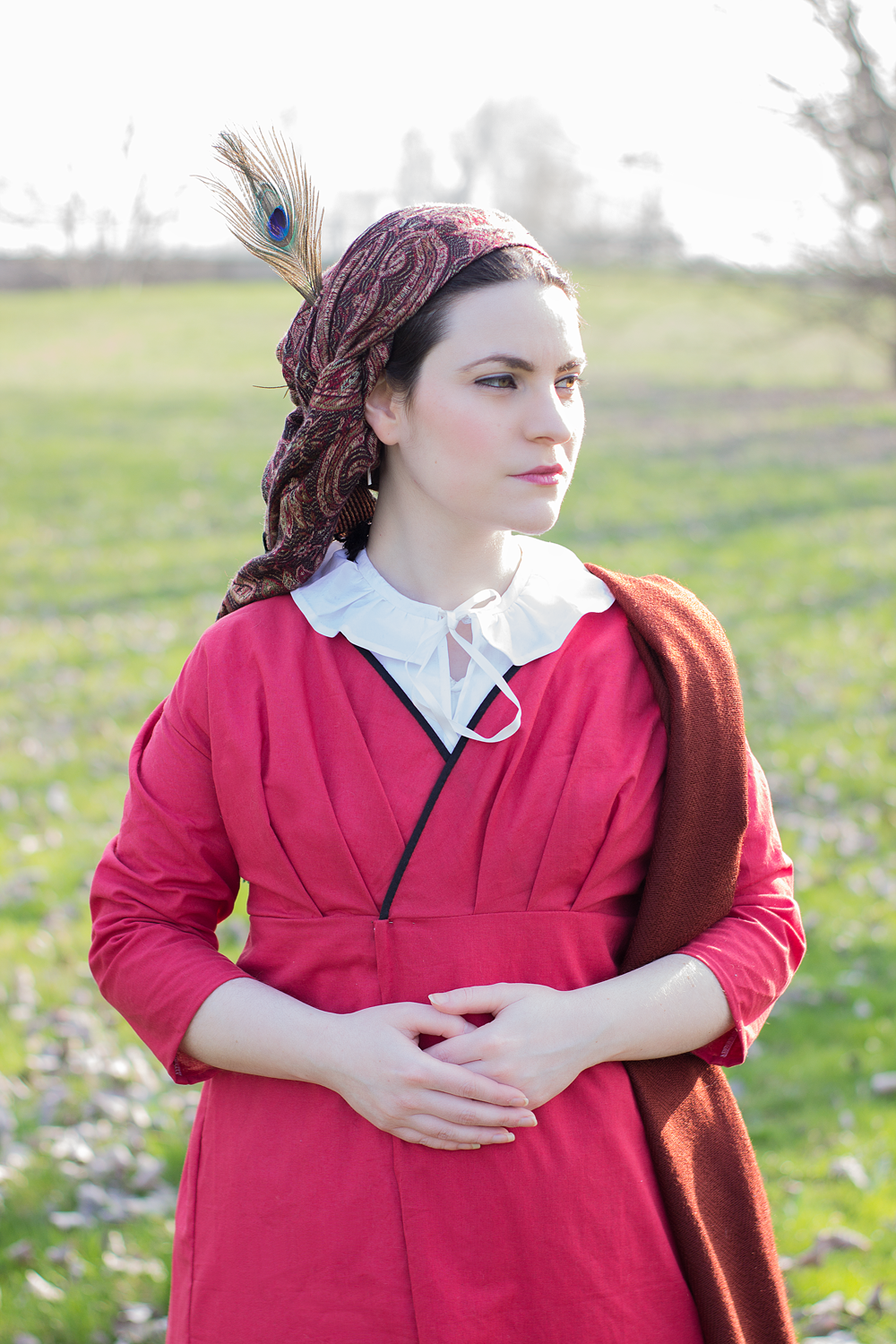
Last month I started to use the S&S patterns my bf gifted me at Christmas and with an incoming event approaching, I decided to make a new dress using some old Ikea fabric in my stash. I really liked the idea of a crossover/wrap gown, definitely different from my other drawstring dresses. I loved the fact to have a front opening dress with pleats at the front, definitely something eye-catching. So I went for "The Elegant Lady's closet" pattern.

Before proceeding with the post, I'd like to say something to beginners. The instructions for this pattern are not so simple as they seem. The bodice calls for a separate lining (not the easiest thing to understand for people not involved in historical costuming...), an extra skirt layer (the easiest addition), dropped shoulders with sleeves set in the back. Trust me, these are not so immediate steps for a beginner. I would recommend to avoid the separate lining and proceed with a basic one (so using the front pieces of the bodice as guide) and to do a mock up of the sleeves before cutting the final fabric. I basted, stitched, ripped  the sleeves various times before getting a clear idea of where they have to sit - especially for the seam. Where's the seam? At the side? At the back? At the front, as in 18th century? A mystery. I placed my seam on front but I'm really not happy. 
Mark everything when transferring the pattern onto the fabric and things should go easily. I also recommend to add the extra skirt layer on the front to avoid a gap while sitting or moving; you should obviously wearing a petticoat underneath but a white gap in a coloured dress (like mine) it's not so fashionable so why make economy for a extra yard of fabric only?
I also avoided the self fabric binding, binding the upper edges with black bias tape to create some contrast. I have seen something similar in a fashion plate of the time.
The skirts are put together using french seams, while the upper edges have been serged. Every hem and the binding is hand sewn. 

Despite these things, the pattern is really easy to put follow. At first I wanted to gather my front pieces but I realized it would have been really bulky so I followed the instructions making the pleats. Much better! My dress closes from left to right, I founded it easier being left-handed. It closes with a pin at the front but I will add some hooks and eyes for more support. 
The back fits tight so measure yourself carefully before cutting the fabric. Chemise, stays and petticoat add some cm to your measurements. 

I matched the dress with the brand new chemisette I made always from S&S and the outfit was so cute! Unfortunately we didn't took many photos during the event due to the bad light but we'll take new shots in two weeks when we'll be again in Stupinigi!
Some photos on the dress form directly from my Etsy shop:


venerdì 21 ottobre 2016

Life, vita di corte: a 18th century day in Stupinigi

Last month I could visit the beautiful palace of Stupinigi not as simple tourist but as reenactor. I'm kinda new into 18 and 19th century reenactment (you're probably tired to read it every time lol) so I was kinda nervous about my costume. We were allowed to wear dresses from 1740-1770 so I originally planned to sew a robe à l'anglaise; due to time and budget, I decided to use a beautiful pink satin fabric two friends gifted me last year but I couldn't figure my anglaise in pink. After looking to my books I decided to make Norah Waugh's sack dress (info e details about the construction in the next post).

I finished the dress and hat the night before the event. I did a fully boned cotton satin stomacher with matching petticoat, cotton ruffles, pink choker and straw bergére hat with paper flowers. For sure I was wearing chemise, stays, pocket hoops and petticoat underneath. 
I started with a pinned bodice but it didn't stay in place so after lunch my boyfriend had to sew the robings to the stomacher to keep me dressed up. I'll never use pins again! 


The dress came together quite easily but has some imperfections I need to fix. I wore very few make up to stay accurate: just red on lips, light pink on cheeks and black mascara. That's all. 

The event was about the daily court life so some of us were dressed like aristocrats and others as servants; we spent the day chatting, walking and taking photos, while some ladies from the group were teaching visitors how to drink hot chocolate (yummy!). 
Walking in the palace has been a real dream. Some furniture is authentic, the mirrors are still bright, the tapestries are fabulous. I felt like the Duchess of Devonshire hehe 


Just to say: keeping my hair up was a nightmare. Trust me. At the end of the day my neck had enough and I had to make a simpler hairstyle (not so accurate but I was suffering). 
I spent most of my day doing embroidery. I started to sew a linen stomacher a couple of months ago and still hadn't the time to finish it. 


We also had the time to take some funny shots ;) 


And now, off to the next event of Life, vita di corte: hunting! Let's make a riding habit then! Thanks for reading! Don't forget to visit Le Vie del Tempo on Facebook for more photos! 


domenica 22 maggio 2016

Natale di Roma 2016

Il mese scorso sono (finalmente) riuscita a partecipare alla manifestazione del "Natale di Roma", un evento giunto ormai alla sua 14°esima edizione. Organizzata dal Gruppo Storico Romano, tale manifestazione ha come scopo quello di celebrare il compleanno della nostra Roma, la cui fondazione sarebbe avvenuta il 21 aprile del 753 a.C. 
Per l'occasione ho preparato due nuovi outfit per me e consorte: una tunica in lino marrone per lui, corredata di lacerna di lana e bracae, e una tunica verde con palla in cotone per me. Il meteo non è stato per niente dei migliori, nessuno si aspettava un freddo simile a Roma specialmente a fine Aprile, e ho dovuto indossare una tunica bianca come strato extra per ripararmi un po'; non era inclusa nel design originale dell'abito, ma pazienza, la vostra matrona era davvero al limite dell'ipotermia.


Andiamo con ordine: il pulmino IX Regio è giunto in quel di Roma il sabato mattina, dopo un'intera nottata di viaggio. Ho subito fatto amicizia con un bellissimo micione tigrato, che ha subito colto l'occasione per saltarmi in braccio e farsi fare (o farmi?) un po' di coccole. Potevo forse dirgli di no?


Dato che le nostre stanze non erano ancora pronte, ci siamo dati al turismo recandoci nient'altro che al sito di Ostia Antica, che non avevo mai visitato. Avete presente i film su Roma, con le botteghe degli artigiani e le famose strade lastricate su cui si muove la folla? Ecco, quando passeggiate per Ostia Antica sembra di rivivere esattamente una di quelle scene - senza la calca dei passanti. Il sito è davvero molto grande e non siamo riusciti a visitarlo tutto, ma merita senza dubbio di essere menzionato il piccolo museo adiacente l'area ristoro, nel quale abbiamo ammirato dei busti, dei marmi e tanti dettagli utili per le riproduzioni dei nostri abiti.


Piccola postilla che renderà felice gli altri gattari sparsi per il mondo: il sito ospita una colonia felina di mici! Ovviamente mi sono lasciata monopolizzare dalle loro richieste d'attenzione, elargendo grattini e coccole (segnalo un micione rosso bellissimo e molto affettuoso, un vero "Romeo" da Aristogatti, che purtroppo non sono riuscita a fotografare).  


La mattina dell'evento è iniziata sotto un cielo parzialmente sereno; giunti al Circo Massimo il sole ha fatto capolino tra le nuvole ma il vento - davvero freddo - non ci ha abbandonato. Verso le 11 il meteo è nuovamente peggiorato e la sfilata si è avviata sotto un cielo plumbeo e minaccioso ma la fortuna è stata dalla nostra e siamo riusciti a compiere l'intero tragitto all'asciutto. Non mi dilungo nei dettagli: sfilare accanto al Colosseo è stata un'emozione incredibile.


Come accennato in precedenza, la tunica bianca che ho indossato non era inclusa e, sinceramente, me l'ero anche dimenticata a casa; nel dubbio ho preferito portarla e non ringrazierò mai abbastanza la mia vocina interiore del "non si sa mai". Quello strato in più, per quanto sottile fosse, mi ha riparato e non oso immaginare cosa avrei patito se fossi stata con le braccia nude; il prossimo anno mi procurerò qualcosa di lana, promesso! La palla in cotone è servita molto bene al suo scopo e l'ho indossata sia come scialle sia come velo, proteggendomi dal vento e dal sole (vi assicuro che nei momenti di cielo il sereno il sole era particolarmente forte). Colgo l'occasione per segnalarvi anche un video accelerato riguardante il making of della tunica, caricato sul mio canale Youtube. Gli orli e le rifiniture esterne sono stati realizzati interamente a mano e questo processo mi ha portato via molto tempo, considerando che solo la palla misurava 3 metri di lunghezza.


Con Giulio Sesto Frontino


Il pomeriggio è trascorso in modo tranquillo, con sprazzi di sole e attività rievocative più "classiche", tra cui la rievocazione della conquista della Britannia da parte del Gruppo Storico Romano, con un'agguerrita Boudicca (se siete lettori più o meno frequenti del mio blog forse vi ricorderete qualche post a lei dedicato). Ovviamente non mi sono lasciata scappare lo shopping e ho acquistato un paio di bellissimi orecchini realizzati dall'esperto dottor Dario Tegani, potendo così arricchire il mio guardaroba romano (il prossimo passo saranno degli anelli o - perché no - qualche bell'accessorio per i capelli). Terminato l'evento siamo tornati al nostro camping e con l'imbrunire è giunta anche la pioggia: se questo non è un segno degli dèi...

Non potevo resistere! 


Questo bellissimo micio è venuto a presentarsi la sera prima della partenza e, indovinate? La mattina successiva è tornato per salutarmi e farsi accarezzare un'ultima volta :)


In conclusione: l'esperienza è stata davvero piacevole e spero di poterla ripetere il prossimo anno (confidando in un meteo migliore!). Per l'occasione ho in mente un nuovo abito e posso solo anticiparvi che sarà molto più ricco e sontuoso rispetto all'attuale: il perché lo scoprirete in futuro ;)
Ave!

Post in evidenza

Edwardian skirt and blouse, circa 1900-1905

I've always been fascinated by the style of early Edwardian era, with those lightweight blouses, fabrics, delicate laces and floating s...