Visualizzazione post con etichetta medieval dress. Mostra tutti i post

venerdì 3 giugno 2016

IX century Anglosaxon - Norman dress

I have several sewing projects for this year, including a bunch of medieval dresses. My last medieval dress was from 2014 (the burgundy Bliaut) so I thought it was time to create something new. I always had a passion for the lines and shapes of early medieval fashion so first of all I did a little bit of research to understand how these dresses were made and cut.
The fashion of this period was not so advanced and the influence of the roman empire is still visible when looking at the cutting diagram: the dresses were cut following simple shapes, often squares, rectangles or semi-circular, and they were studied to save most fabric as possible. Women's fashion of 11th century featured two basic garments: an under dress with fitted sleeves and a knee length super tunic, including a oval veil to cover the hair. This kind of fashion works perfect for the late Anglo-Saxon period and the early Norman kingdom. 


I chose brown and ivory linen for my project. I wanted something simple and practical, something completely different from my other dresses; the medium weight linen worked great for this purpose: it gives a "everyday" look and the simple linen trims add that touch of elegance perfect for lower-middle classes. 
The tunic fits like a glove and it's really comfortable. The sleeves are faced inwards and there's no visible machine stitching from the outside. The super tunic falls gently on the body and looks great with or without belt; the neckline is faced outwards and every hem has been hand sewn with cotton thread and medium sized stitches. The skirts float so nicely together when moving!


The faced neckline

The veil was a challenge. It was really easy to be made (all hand sewn) but wearing it has been more difficult. I had to make several fittings before finding a nice way to drape it over the shoulders, the secret is to put the longest part of the veil on the head and then wearing a leather or metal crown to keep it secured on the head; the shorter part needs to be draped on the shoulders or tucked behind the neck. The important is to hide the hair completely and - very important - the ears: this might sound strange but covering the ears was not only a sign of modesty but a way to protect women from...pregnancies (during Middle Ages it was widely believed the Virgin Mary was inseminated by the Holy Spirit through her ear).


A version of the dress without all the trim

To complete the outfit I sewn a white under dress in fine lightweight linen as well. This piece has a modern construction on the inside but the outer elements have been all hand sewn.
I'm often asked if chemise (or shifts) are important when recreating an historical garment; the answer is yes, absolutely. Chemises/shifts/under dresses are the foundation of an accurate, well-made garment and they make the difference. First of all, they are the foundation of your wardrobe as you lived in this garment; people was supposed to own a bunch of these which were frequently washed,. They lived in an era when human bathing was not frequent. The chemise helped you to protect not only your body but your outer clothes too (often more expensive), acting as a barrier and keeping them clean from dirt and body oils. So yeah, when purchasing/sewing an historical outfit please don't forget to add a chemise as basic undergarment.  


And so here I am, wearing the whole outfit during my latest costume exhibition :)


The items are listed on our Etsy shop and are available in three different standard sizes (S, M, L).
Thanks for reading!


martedì 19 gennaio 2016

A medieval-fantasy gown: Eowyn

Do you remember the green and gold velvet gown worn by Eowyn in "The Two Towers"? The movie came out in 2002 and since then I've been a huge fan of that dress. It looks soooo medieval, with the long hanging sleeves and the beautiful gold details...a dream! I never had enough budget to buy a replica of the costume so - ta-dah! - I bought a commercial pattern to sew my own version. The pattern still lays in its envelope due to lack of time but I managed to sew a very personal version of the costume with matching colours but a different design. 


For this costume I used a beautiful emerald green crushed velvet as main fabric and gold satin for the contrasting panel and the lining of hood and sleeves. I'm not a fan of poly satin 'cause it frays a lot and it's looks really cheap but you know - budget is budget. To my customers I recommend to choose taffeta, which has a richer texture than satin and looks less fancy.
The dress design is a classic: a medieval-fantasy dress with hood and square neckline, with front and back lacing. Nothing new but this is the kind of dresses which fits me at best and I love to make. 
The lacing is made of fabric eyelets and satin ribbon. To hide the arm seam I hand sewn a piece of gold trim. 


The dress is really comfortable and the lacing allows a perfect fitting. I enjoyed a lot these photos in the woods - the beautiful necklace I'm wearing is by Aeternum Nocturne Jewellery
The hood is wide and covers the head like a glove, falling on the shoulders when not worn. The satin lining falls nicely on the skin and I love how it turns on the outside when the arms are left in a lower position. The crushed velvet is so bright and follows the curves of the body, a blessing for ladies who have large hips like me. 

Some professional photos:


This costume is listed on my Etsy shop and can be ordered in different sizes and colours. Feel free to leave a comment if you have questions about! 


mercoledì 28 gennaio 2015

Workshop allo Studio Cromosoma (Roma) - Dicembre 2014

Sono un po' in ritardo ma, come ben sapete, la mia presenza sul blog risulta essere sempre esigua. 
Il mese scorso ci siamo recati a Roma per un workshop fotografico organizzato presso la sede dello Studio Cromosoma, sito in via Ferruzzano 46 (nei pressi della fermata metro di Anagnina), il cui tema era la post produzione. A presenziare come modelle, io e la bellissima Julia Werecat, artista molto esperta e conosciuta nell'ambiente fotografico alternativo e non. 


I generi presentati sono stati essenzialmente due: storico/fantasy e gothic/steampunk. Per l'occasione ho potuto sfoggiare il mio nuovissimo abito rococò, abbinato a un vestito fantasy in velluto beige (doveva essere bianco - in partenza - ma per una serie di circostanze ho ripiegato su una tonalità leggermente più scura) che tanto risalta con il mio nuovo colore di capelli (per chi non se ne fosse accorto, ho detto addio alla mia chioma ramata...almeno per ora). 

Alcuni scatti realizzati durante il WS: 


By Asdrubale Gallo

By Donatella Coricelli


...Del backstage...


E un video, che non guasta mai! 


Il workshop si è svolto in un clima di grande tranquillità e dopo la sessione di scatti, Lele Photography ha svelato ai presenti i suoi segreti di Photoshop, custoditi gelosamente e rivelati ai soli allievi (ovviamente il tutto è ironico, potete visionare moltissimi tutorial gratuiti sul suo canale Youtube). 
La giornata è letteralmente volata e si è conclusa con una bella pizza. Direi che ce la siamo meritata, no?


Un ringraziamento speciale va ai partecipanti di questo evento, che hanno riposto fiducia in noi e nel nostro lavoro. Alla prossima! 

Fotina di gruppo! 
Dimenticavo...Visitate anche il post relativo alla giornata sul blog ufficiale dello Studio Cromosoma! 

lunedì 20 ottobre 2014

A medieval dress: Butterick 4571 review

Hello!
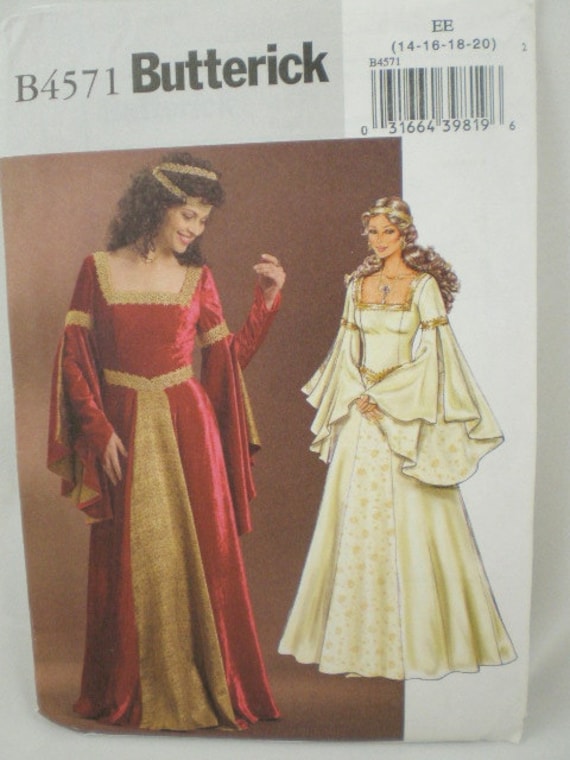
Some weeks ago I got in my inbox a sweet gift the amazing model and costumer Jeanette Cederström Karlsson from Sweden. She sent me some beautiful jewels to modelling with and I immediately thought they would have been great with a costume I was planning to sew. I saw this pattern by Butterick several months ago on Ebay but I wasn't interested in it since I wasn't planning to craft a medieval/fantasy dress with a fitted bodice and sleeves: 


Then I thought I had to try something different from my normal kind of dresses, and so I bought it. The line of the dress is really nice, with a huge square neckline and double sleeves. I felt in love with the white design on the right but since I don't love how pure white looks on me, I bought a sand crushed velvet. I find Butterick patterns richer in illustrations than Simplicity ones, but the instructions are very poor. This dress looks good on tall girls with a nice breast, and I'm not tall or prosperous neither lol! I used a size 10 but the dress fits quite large. I avoided the laced closure on the back but I had to tighten the bodice a lot; on the other hand, the skirt was perfect. The construction of the gown has been quite simple except for the wrong size and the kind of fabric which isn't hard enough to stay fitted around the bust. I had to add a strip of white lace on to hide the generous neckline. Hiding the seam of the waist line has been hard as well: the fabric I used was too soft and continued to fall down so I had to hide it with a belt instead of the wide trim which appears on the pattern cover. 
The skirt is really wide and with a beautiful train. At last, I decorated the neckline and upper arms with a beautiful gold trim.


The dress is wonderful and really rich but...okay...I don't like how it fits me. I have to keep a rigid posture during the whole shooting to avoid wrinkles on the bodice. So bad. 
The belt I'm wearing in these shots is by Armstreet but then I sewn one by my own in white satin. 
I didn't take many photos during the work in progress but I've to admit it looks really good in professional shootings. 

Here you can find the photos taken with the jewellery by Jeanette. The jewels she sent me consist in a crown, a pair of earrings and a choker. 

All photos have been taken and processed by Lele Photography


Don't forget to visit her pages:


Some updates at September-October 2015:

I completely re-sewn the dress. Every part has been unstitched and sewn again. After a whole year of work my skills improved quite a lot and yeah, my creations cannot be compared to the previous ones thanks to my serger. So I serged this costume and I did few alterations for a new fitting since I decided to sell it. This is not my kind of style, my hips are too large to suit this design and so alas, it will be listed on my Etsy shop in a while. 
The bodice has been resized to a bust of 85 cm and I added metal eyelets replacing the old lace lacing. The trim has been stitched again, all by hand, for a perfect finish. The neckline has been raised up so I could avoid the lace strip (I don't have a generous bust so I hate when clothes fall off) and has been trimmed with cotton bias tape.
The trim has been applied to the pointy sleeves - so medieval! 

I love, love, love how it turned out! I recently sewn a similar dress in white for a customer but I'll talk about it in another post ;) 


For orders and commissions: www.etsy.com/shop/ilfiorenero or ilfiorenero@hotmail.com


My Bliaut inspired dress (XII-XIII century)

Hello there!
Today I'm here to talk you about one of my last sewing projects. I was a reenactor years ago and I 've always been in love with the medieval dress for excellence, the Norman "bliaut". It's the typical, feminine, medieval dress with long sleeves and V neckline, the fitted waist and the flattering skirt. This model was very popular during Norman period in Europe, around XI and XII century. 
I never had enough money to buy a good bliaut so I chose to sew one by my own. It's not accurate (as my other costumes) 'cause good historical dresses need lot of money I don't have at the moment. I try to do the best I can with my own resources. 
For my bliaut I used about 4 mt of burgundy linen and 6 mt of embroidered trim. The pattern has been designed by myself, using an old medieval dress which I bought online years ago as reference (very similar to the historical model). I did some variations: my original dress has lacing on the back and I substituted it with a more accurate side lacing with hand-sewn round eyelets. The result is more or less this one (see photo below).
I'm not a great fan of linen (especially if it's not soft) and I try to avoid it every time I can. A good bliaut can be sewn in silk as well for a very noble look but I wanted to give to linen another chance and so I bought it. I found the woven trim at a local market for a very cheap and affordable price. 

After cutting the fabric I pinned both sides and sleeves obtaining this result: 

 photo IMG_20140824_231843_zpsdb29b792.png

 photo IMG_20140825_124645_zps4ed661f1.png


The dress was too tight on the hips for my tastes and so I added the side lacing to adjust it (I'd like to thank my friend Cristiano for his precious suggestion about side lacing! - he saved this project). The solution was simply perfect and the dress fitted me perfectly. So I started adding the trim on sleeves, neckline and hem. I had enough trim enough for a belt too.

 photo IMG_20140828_194310_zps4528cbe6.png

 photo IMG_20140826_165418_zps2cb91c5f.png

Some photos of the finished dress: 


I love, love how it turned out! The sleeves could be more fitted and the skirt wider, but I don't care. I'm planning a matching veil for a more accurate look. 


Post in evidenza

Edwardian skirt and blouse, circa 1900-1905

I've always been fascinated by the style of early Edwardian era, with those lightweight blouses, fabrics, delicate laces and floating s...