giovedì 1 ottobre 2020

1890s Cheerios jacket

 Let's talk about another project made this year during the lockdown. Take a drink, eat popcorn because this jacket has a long story. I called this project "Cheerios" because of the colour of the fabric. 

After watching Crimson Peak movie a couple of years ago I fell in love with the costumes and immediately wanted to reproduce the yellow dress, though it's not properly my colour. I went to the fabric shop, found some lovely mustard cotton but then I realized it wasn't enough for a complete dress. Nevermind, I bought it with the intention to make a fitted bodice. I adapted the pattern to my measures, cut the mockup, did some fittings, cut sleeves lining...and put everything in a box for 3 or 4 years. Don't ask me why I didn't finish it before. There was something wrong with me and my mind and I was literally afraid to start working on that out of stock cotton (you know...no room for error!). 

So I waited. And waited. And waited. Until last year, when I found the mock up in a box and remembered of this project. I put the mockup on the dress form and it looked ok but when I tried it on, I immediately realized there was no enough room for the overlap at center fronts. I did darts smaller, put a facing. Nothing. It was way too tight. This was probably the reason why I didn't finish it back then. Totally discouraged, I took the mock up and put in the box for some months again. 

During the lockdown I was looking for some easy sewing projects to do using stash materials as long as I couldn't order something new and - oh! - this little thing came to my mind again. This time the sewing Gods were with me. I tried the mock up on and - omfg - I understood I could turn the bodice into a fitted jacket with reverse, MY FAVOURITE THING! Squeeee! I rip the mock up, cut the fashion fabric, assembled the whole thing and admired how beautifully this jacket looked with a plastron instead of a sleeveless blouse. 


I ordered an antique silk organza and lace plastron on eBay but alas it was too delicate so I used it as reference to draft a pattern and make one of my own using some cotton and laces from stash. So much better as I could move and breath in the jacket without ruining the delicate silk organza. After finishing the bodice and adding the boning  I worked with the sleeves, which were incredibly big; they are attached to a fitted sleeve lining so there's no way to use sleeve supports; I stitched some netting in the upper cap of the sleeve to give just some support. 


Then I made buttonholes (later covered by hand) and used vintage honey buttons to close it. 


And it was done!

Then summer came and couldn't wear it until last weekend, when the weather finally allowed me to  put it on for the whole day. And my friends, it was a success! Enjoy! Sometimes it's amazing to see how wrong projects can turn into something beautiful and unexpected. I wore it with a matching hat with vintage veiling, antique silver buckle, gold pleated earrings and antique cammeo. 


mercoledì 30 settembre 2020

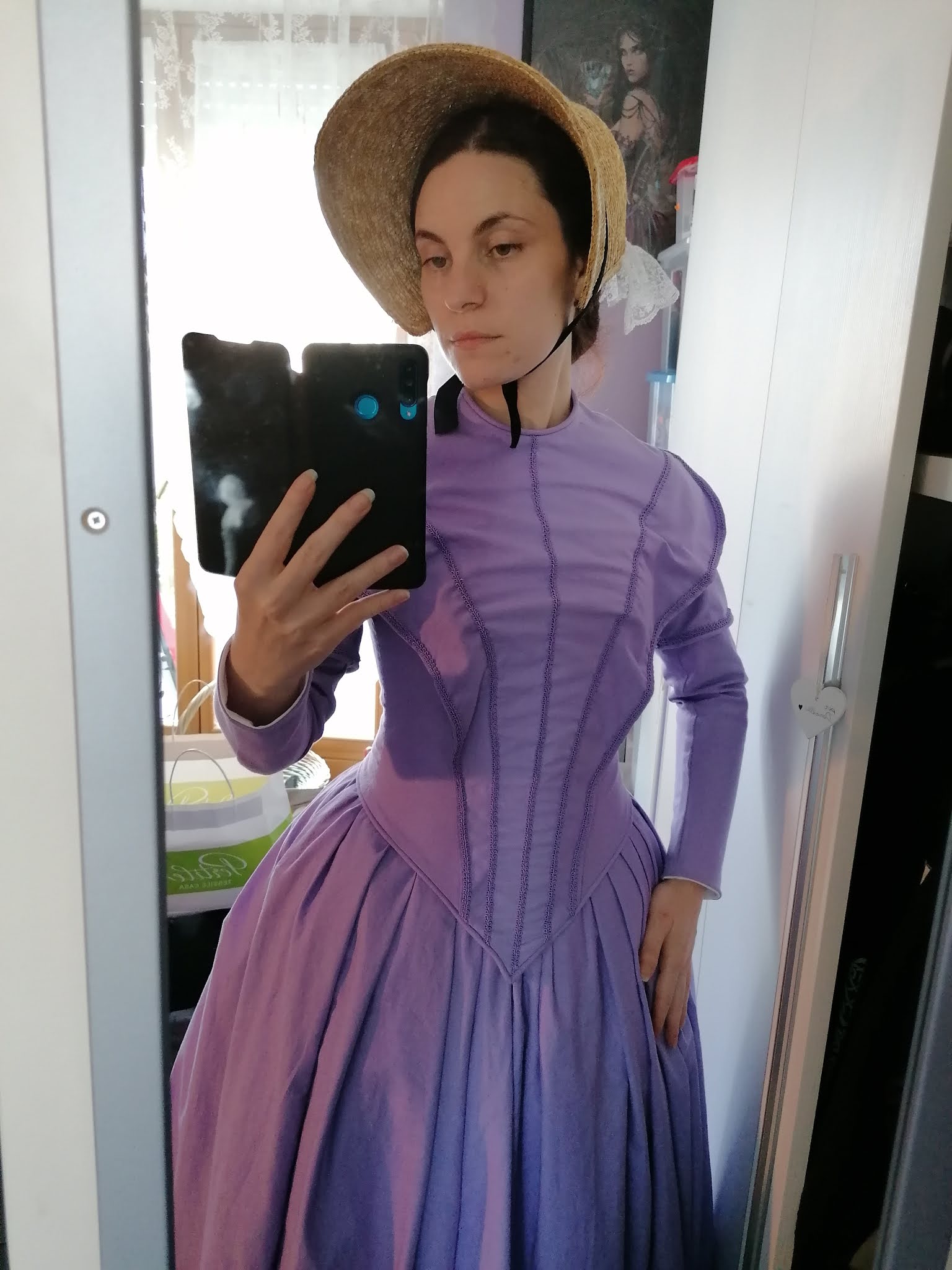
1840s lilac dress

 Let's update this blog a little! Summer has passed (finally!) and this year I have been able to finish a couple of projects due to human temperatures until August... The projects are not in chronological order, I'm going to write about as long as I remember them.

First, a new 1840s dress. I had this lovely lilac cotton in stash for approx 2 years and decided to use it after a looooong wait. I already have a 1840s dress made in 2019 with a fan front but I wanted something different. I used my trusted TV German Day Dress pattern as base for the bodice, while sleeves and skirt are self drafted. I started this project at the beginning of September because I remembered the first version didn't take so long but I was wrong: the bodice took a lot. Almost 2 weeks. 1840s dresses may sound easy but they are not! The sleeves are fitted and have to be well drafted, same as for the elongated waistline in the bodice. Fittings took a while. I had no problems with the longer waistline (the facing piping took away 2,5 cm in lower edge and neckline so it shortened a lot!) but the fit of the bodice was a pain. 


I have a weird body with a very small neck but wider shoulders and a "medium" waist, which forces me to make a mix and match of my pattern pieces. My dressform has a huge neck so I can't drape my own patterns over it and this is a problem with back fastening gowns like these. I did all my best to achieve a good fit but the neck is still gaping and the hooks get unhooked. So boring. On the other hand, the bodice was so well fitted along the waistline there's not so much overlap for the hooks. I'm pretty sure these ladies had someone helping them when making their dresses because it's impossible to get a good fit without another pair of eyes... Front closure next time. No way. Or buttons. Buttons are lovely! 


Despite these issues, the bodice came together quite well. I just take in some extra cm in the neck and bust area. The bodice is flat lined in cotton, serged, boned in all seams and then trimmed with this lovely lilac braid I purchased online. I wanted to use only stash materials so I used what I had on hand, including this bold cotton cord for piping. 


The skirt was a breeze if compared with the bodice. Two rectangles pleated to the waistband with a faced hem and the same braid to cover the stitches. So easy and relaxing! 


I completed the look with a straw spoon bonnet from Nehelenia Patterns, trimmed with vintage decorations and cotton sateen ties again from stash. The dress is worn over chemise, corset, corded and tucked petticoat. I only realized my corset provokes a bad wrinkle at top of the bodice for unknown reasons (this was not present when making fittings...) so I will have to fix that together with the back fastening. The day of the event the weather was rainy, cold and cloudy so I had to wear a shawl to protect me a little; the silk parasol was just for scenographic reasons... ;) 


lunedì 29 giugno 2020

WW1 skirt and blouse (Wearing History patterns review)

So, a long time has passed since my latest post. The Covid lockdown changed many things and I was not in the mood for blogging and talking about costumes. But here we are again! I did a couple of projects during the lockdown, including a WW1 outfit that was on my to-do list from some months. Being a huge fan of 1910s fashion as you may know, I definitely had to try late Edwardian styles. It's not a popular period, especially here in Europe, so when I came across Wearing History patterns I decided I had to try it. Clothes of the period changed dramatically if compared to pre-ww1 years and skirts became shorter and larger to allow more movement since women became more active and started to work outside the house. The blouses lost more of the their frills ending in very practical garments we can still wear today. 


I started with the blouse which came together very quickly and easily. The cuffs have a lovely point which is optional if you aim a modern look. It has a drawstring at the waist for ease of wear and fitting but you can also switch to a fixed waistband. The original pattern followed the symbols and the instructions of the original one, released in 1910s; I never used antique patterns before but once you have sewing basics, you can easily do it (also Lauren has some lovely how-to videos on her YT channel where she explains how to put the blouse together).
I used white cotton from stash and mother-of-pearl buttons as fastening with machine sewn buttonholes. Collar and lapels have topstitching. The fit of the blouse was incredibly perfect and only the cuffs required some alterations but it's because I have small wrists and every commercial pattern fits large. 

The skirt is included in a huge pattern that allows you to make a full walking suit with a jacket for colder weather. I didn't' made the jacket yet but I plan to make it this fall. I used some purple cotton from stash to make the skirt and the same buttons of the blouse. Buttons are just decorative: the skirt opens and closes at front with a series of snaps since I was out of thread (lockdown, remember?) and could not purchase it. This was the easiest part of the project. It's made just of two pieces with optional external belt and you can choose two different lengths: the longer works for early Edwardian era, the shorter for WW1. Being just 160cm tall the shorter length fits a tad longer than I expected but it's ok since it hits my ankles. As you can see the skirt is pretty much high waisted and this requires a carefully fitting if you don't want your skirt to move or fall down when wearing it. There's a inner belt to stabilize it. 
The skirt also needs a little bit of support so consider in making a short petticoat with a ruffle as I did. 


I completed the look with a new antique silk parasol dating to 1917 (it has a looong handle and it's huuuuge when fully open) and a proper small hat made using some black cotton and feathers from stash. I'm very happy with this new outfit and I can't wait to wear it properly with a pair of Suffragettes earrings I just ordered. 
I forgot to add the whole outfit is worn over chemise and proper underwear but it would look absolutely lovely with modern undies! 

mercoledì 29 gennaio 2020

Ancient Roman stola and veil in cotton gauze

I made this outfit several years ago so consider it a restyle. I was sure to have talked about this project on the blog after wearing the dress for the first time but I was wrong... The post is missing so this means I didn't write a thing. 
If you followed me for a while you probably understood Ancient Roman fashion is one of my favourites styles; it's simple to make, cheap and very comfy to wear since it's made just of rectangles or geometric shapes fitted to the body with belts. Sounds easy, uh? 

After making and selling a couple of dresses I decided to keep the green cotton tunic I wore at Natale di Roma in 2016 for me. I always disliked how the apple green/yellow palla looked on me so I discarded and reused it for other projects (mainly linings and know what? It works perfectly as support for Victorian bodices!), buying some crinkle cotton to make a stola. 
What is a stola? Today we use this therm to indicate a shawl but in Roman times, a stola was an outer garment worn by married women. It's basically a tunic sewn at sides pinned at shoulders with brooches, forming a tube that falls in lovely folds around the bust. It doesn't have sleeves because they form automatically when pinning the edges of the neckline above on the shoulders. 
The stola can be made in a great range of fabrics, from silks to linen, and colours. 
Mine is brown, the only colour I could pair easily with green. It's shaped to the body just with a cotton tape that works as a belt; the stola is a couple of cm longer than my height to allow draping at waist.


The brooches are a reproduction I got from Celtic Web Merchant and work really good. The stola, as the tunic, is machine sewn inside but hand finished outside. I completed the look with a crinkle cotton veil instead of a full palla, which would have made the outfit too heavy to wear in the summer heat. 

This complete outfit, or just the stola, can be ordered on Etsy according to your measures and personal tastes!

Full outfit:

Stola only: 

Post in evidenza

Edwardian skirt and blouse, circa 1900-1905

I've always been fascinated by the style of early Edwardian era, with those lightweight blouses, fabrics, delicate laces and floating s...