Visualizzazione post con etichetta rococo. Mostra tutti i post

sabato 28 aprile 2018

A 1750s Ikea floral caraco

New season, new project! Well, to be honest this one was started this winter but you know, I don't have lot of free time to sew for myself. If you read my previous post about 18th century fichus you may have noticed a new, lovely, floral caraco.


I started it between January and February for an event at the end of March, using some cotton from stash as lining (you know, economy!) aaand approx two yards of this famous Ikea fabric. This kind of cotton is thicker than Ljusoga duvet so keep it in mind when buying: it wouldn't work good for a summer dress or jacket. The price is about 5€ at yard so it's definitely budget friendly! 
"Luckily" our event ended to be really cold and windy and the caraco worked perfectly as mid-season garment. 

I used the famous caraco pattern shown in "Patterns of Fashion 1" by Janet Arnold with some alterations. A very, very similar version if you're not good at scaling up patterns can be found on JP Ryan online shop; I loved her cuffs so I used her draws as reference to make mine. I also added a side seam to the bodice to make it a little bit different to my robe à l'anglaise.  My.ma in reference was this beautiful extant piece:


First, I printed the pattern and adjusted to fit my body. I have very large back shoulders and I always have to enlarge period patterns a lot to fit this area. Then, I raised the neckline quite a lot, added cuffs,  attached fine cotton engageantes and a lovely small strip to the bodice to keep my fichu in place. I also omitted hooks and eyes closure for a more practical one with pins since I'm currently losing weigth. When I made the mock up the sleeves were perfectly fitted but now, in just two months, they run large but I can live with that. The rest is still perfect and the back so incredibly well fitted, yay! 
The front edges are boned with synthetic whalebone.


The skirts have two lovely box pleats in the side seams which give to the caraco a very elegant, flattering look. They need to be worn over pocket hoops to show their volume at best. I wore the whole thing with a brown linen skirt and a cotton petticoat. I'm planning a lighter one in red. 

The caraco came together really easily. It doesn't have a waist seam and the wrinkle you have at sides is absolutely correct. I made the lining first and joined it to the fashion fabric as a separate piece; the lining and the fabric have been joined by hand. As usual, my garments have machine made seams but hand finished details. I skipped trims and decorations for now: they can always be added later. 
I could work on it for a very limited period of time but on a normal schedule I would have finished it in a week/ a couple of days.  

I didn't take many pics of the construction, it was really straightforward. I was thinking to add this lovely piece to my Etsy shop as made to order item in different sizes, who knows...


venerdì 20 aprile 2018

A brief summary of 18th century fichus

If you're into 18th century costuming or reenactment, you may have heard of fichus also known as modesty scarf. These little, versatile piece of a woman's wardrobe was an essential accessory to fill/cover a bare neckline especially during the day. It could also be used to project the skin from the sun during summertime. Women of upper and lower classes both wore their modesty scarves.

Fichus comes in a variety of widths and materials and were usually white, made of lace or linen, and could be worn tucked into the neckline or falling above the shoulders, or laced behind the back if very long. Hey could also being embroidered or embellishwed with lace. Usually they had a triangular shape with a small slit at center back to allow a gently fit. 


My fichu is made of beautiful cotton sateen produced locally and ends in a lovely point at the back. I tuck it into a strip of fabric pinned to my floral caraco, which is not only a practical solution but also a fashionable choice.

If you look at period resources, you can see how common fichus were and how different they could be from each other.


Did you already heard about fichus? Are you planning to make one to complete your 18th century outfit? Let me know! 


lunedì 5 marzo 2018

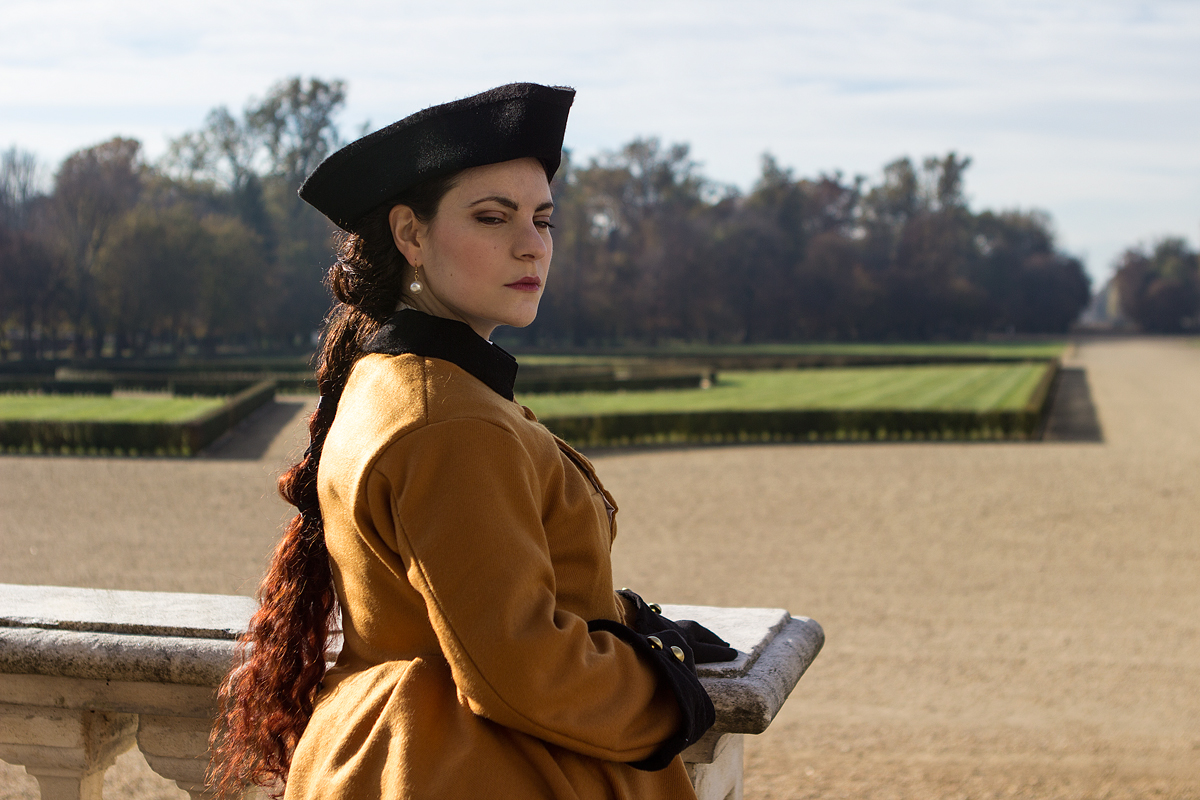
A 1750s brown linen caraco

Quite old project here, a creation I made last summer and I never wrote about! Shame on me! This little piece was a last minute project I made for an event last September but despite its simplicity, it turned out very well and it's lovely to wear.

Our event was set in the first half of 18th century and my closet wasn't equipped for that era. Being in the middle of the Halloween costuming season I really didn't have time to make a whole dress for me, including pattern drafting, mock ups, alterations and so on. So I looked in my stash and I found some scraps of the same brown linen of my previously made Outlander skirt. I cheated and used the same jacket pattern from Janet Arnold with some very basic alterations to draft the pattern of a mid-18th century caraco! The whole process took just about two days, yay! 

The whole thing came together so pretty that I decided to wear it again the week after in Tuscany. If you follow me on Instagram I'm pretty sure you already saw these photos. 


More are following...so keep on reading! 

So, as told before I used the same pattern of my blue Outlander jacket with just a few alterations. I just added winged cuffs (now removed) and elongated the skirt, using the body pieces instead of adding a separate peplum. This was definitely easier but it had to be done carefully because a wrong side length could cause wrinkles in the waist area (and you want a smooth bodice, right?). My side length (measuring over hoops) is 19.5 cm plus 1.5 of sleeve seam allowance so it is 21 cm in total. I added 22 cm more to this measurement to have a lovely and flowing skirts (2 cm were for the hem). When drafting skirts, please be generous and measure twice before cutting! Skirts HAVE to flare over your skirt support without pulling or be too tight; use all fabric width if possible and if not, add gores. 

I sewed the cotton lining using the modern method right side VS right side and turning, then I hand sew some small running stitching to give the illusion of a hand-sewn garment. The stomacher is a separate piece and it's joined to the jacket with pins. 

Some construction photos...


And other photos of the caraco worn - again in working/middle class style. I definitely need a better cap. 
Photos by Letizia Taschetta:


Look at the back fit: yummy!

Aaaaaand...some fancy photos! Let's rock 18th century with some modelling attitude! Photos by Roberto Buonafina.


Little update: I DID talk about this jacket last year, but completely forgot about that post. You can read the original discussion here

venerdì 2 dicembre 2016

1750s wool riding habit from "Patterns of fashion I" by Janet Arnold

For my latest reenactment event in Stupinigi I had to sew a ridign habit, since the theme of the day was hunting and I didn't own a proper dress. I always loved riding habits from 18 and 19th century so I immediately started to look for references from paintings and extant gowns,
Riding habits were extremely popoular at that time and were also used for walking or travelling, so were versatile; they were inspired by mens fashion so they were often made by tailors following traditional male techniques, as buttonholes on the left side instead on the right. They could be richily decorated or simpler, with long or short skirts, worn open or closed on the bust. Blue and red were popoular and fashionable colours. 


I wanted it in velvet but I thought it would have been too pretentious to be a first riding costume so I went for wool. I didn't have a particoular colour in mind and I chose a pumpink wool I found at a very good price in my home town. I also bought black wool for waistcoat, collar and cuffs. I wanted to look the most accurate as possible so I wore the proper undergarments (chemise, stays, pocket hoops, petticoat and riding shirt) including the riding waistcoat; now the fun part: tailoring. Seriously, tailoring is totally different from regular dressmaking. For my waistcoat I used my Outlander jacket as reference for the main body, enlarging the front pieces and elongating a lot the skirts as seen in "Patterns of Fashion" and "The cut of women's clothes"; the back has lacing as the male waistcoats. It is lined in cotton and it came together really quicly (sadly I didn't take photos of it during the event!) with hand finishing on the outside but machine sewn buttonholes. It was really warm! 

Now the riding habit. The skirt is a classic 18th century skirt made of rectangles with slits at sides and a waistband. I didn't took photos of the construction since I think almost all us know how to make a 18th century skirt properly =) It ended to be longer than I expected so I will have to hem it again in the future. 
The jacket was longer to make. I used Waugh's pattern to start but I definitely abandoned it because I disliked the dropped waist in the back skirts (The Antique Sewist explains this issue in her blog perfectly with lot of photos of the finished garment) so I referred to Janet Arnold. The pattern was kinda easy to draft but I did some alterations in the skirts and omitted the side pockets. The collar is from Waugh's pattern - it was faster to make. 

Janet Arnold pattern

The back and the sleeves fit perfecly but there are some issues with the front. The jacket looks bulky and too long and this is probably due to the position of my old pocket hoops. The front edges of the jacket are reinforced with canvas according to the pattern instructions. 
The pockets and the hems have been stitched with whipstitches on the inside and visible stitiches on the outside to keep lining in place. Cuffs and pockets have been them embellished with gold metallic buttons. 


Et voilà!

I forgot: the book "Patterns of fashion" is available on Amazon and can be purchased here: Patterns of Fashion: 1660-1860

mercoledì 23 novembre 2016

Pink robe à la française from Norah Waugh "The cut of womens' clothes"

As stated in a previous post, I attended a 18th century reenactment event in September and had to sew a proper court dress. I already had some beautiful pink satin in my stash so I just had to decide which kind of dress I wanted to wear; I couldn't get decided between the classic sack dress and the more comfortable (in my own opinion...) robe à l'anglaise, and in the end I went for the first one which looked better in pink.
I used the pattern provided by The Cut of Women's Clothes by Norah Waugh and I can say it surprised  me: the pattern needed just some basic alterations and the dress came together really quickly. The Watteau pleats took a while to be done and aren't still perfect but I'll work on them later. 

Now, my pattern:

I took the measurements wearing full undergarments but - however - the sides ended to be longer than I expected, giving the bodice a clumsy look. The back of the bodice has eyelets for accuracy and it's all flat lined in cotton to add more support; on the other hand, the sleeves and the skirts fit perfectly.
The stomacher is fully boned and it's a separate piece pinned to the stays; at the beginning of the day I pinned it to the dress but the weight of my satin stressed it a lot so we stitched it to the robings. The petticoat is made of the same ivory brocade of the stomacher but just at the front; the rest of the petticoat is made of cotton. The whole dress is trimmed with white cotton ruffles, all pinked by hand and hand sewn over the robings and skirt openings.

For those who asked...no it's not a wig :) I also wore a cheap straw hat with paper flowers since I didn't manage to sew a lace cap.
To be honest this dress is not a masterpiece but it's ok to be the first sack dress and to have finished it the night before the event. There are several issues to fix but we're all here to learn =) I dislike the lower sleeeves too, they're too big and cover the engageantes completely.
It was a very sunny day and my delicate eyes couldn't stand the light enough to take some decent outdoor shots so excuse for my bad expressions!

Pros:
- I learned to drape Watteau pleats better
- Proper colour and fabric choice
- Easy pattern to work with

Cons:
- Not too wide panniers
- Bodice sides too long
- Engageantes not visible as I wanted


Some references I used, dating from 1750 to 1770:


Post in evidenza

Edwardian skirt and blouse, circa 1900-1905

I've always been fascinated by the style of early Edwardian era, with those lightweight blouses, fabrics, delicate laces and floating s...