giovedì 22 novembre 2018

1780s blue round gown from MoMu museum

New season, new costume replica. Not that new, considering I was thinking to reproduce this dress from 2016 or so... It took me two years of planning, waiting, looking for sources, collecting fabrics, waiting again, patterning and so on but I did it! 


I'm talking about this famous 1780s round gown (also labelled as Levite) from MoMu museum in Antwerp! I guess many of you already saw these photos on Pinterest...


There are very few resources available about this dress and very few photos as well. It's shown with or without lace cuffs and the big fichu hides the back completely, making the visual understanding of the garment almost impossible. Bodice front also looks like pinned or closed with well hidden hooks.
The skirt pleating also looks weird for 18th century standards and if you came to this conclusion you're absolutely right. The lady of Atelier Nostalgia (check all her social media, she makes gorgeous costumes!) was so kind to explain me the skirt was re-pleated in 1860s, I suppose to accommodate the new fashion trends. She's Dutch so she definitely has more info about this dress (thanks dear!). 
This really helped me in figuring out how my dress was going to be. 

The pattern
I altered my robe à l'anglaise pattern and used it as base for bodice and skirt. Being a round gown, the front skirt is attached to the back skirt at sides, as a normal 18th century skirt you'd wear as a separate garment. It sounds confusing but it's really easy to understand how it works when you're going to wear the dress. The beauty of round gowns is you don't have to make a full, separate skirt, you have all you need in a single dress but - on the other hand - you cannot play with different skirts to create a variety of looks. 
For the back I went for en fourreau cut. Worst idea ever. I never worked with en fourreau cuts before and I've to say they're not easy as they seem. The pleats have to be made before sewing the back to the rest of the bodice, need to be ironed and basted carefully to look symmetrical and then hand stitched to the lining to be secured. Sounds easy? Not at all. My back turned out lovely but not so perfect so I wouldn't recommend this technique to a beginner.
The long sleeves of the dress were self drafted using the 1790s sleeve diagram provided by American Duchess in her book. 
The skirts were made as usual, cutting the back longer according to my measurements across the faux cul and folding the excess at front inside the waistband. Of course I left slits open at sides to reach my hanging pockets underneath. 


I decided to close my bodice with pins as usual. Pinning is not only historical accurate, it also permits you to wear your beautiful dress if subjected to weight alterations. 

The fabric
Italian cotton in petrol blue, really similar to the original one (which was in silk taffeta), cotton sateen for the fichu and bodice lining, silk organza for the cap and net lace for the sleeves. 

Working time
I would say the working process took about a week but because I had to pattern the sleeves from zero and I struggled a lot with the back pleats; otherwise, I would have been able to complete it in 5 days or so. Of course this dress features lot of hand stitching. 

And now...the photos! When we took the pics (it was during an event so excuse the people and the modern elements on the background) it was rainy, cloudy and muddy so I wore my wool short cape to stay warm. 


Another mission completed! Now let's back to work on another reproduction, this time from Kyoto Costume Institute in Japan :) 


lunedì 8 ottobre 2018

1910s walking dress (revisited)

Available on Etsy: HERE

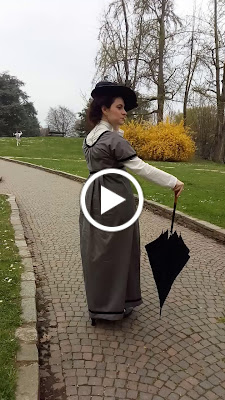
A project from a couple of months ago, at the beginning of the spring. I had to attend a Belle Epoque picnic in Turin in the city center, so I needed a dress elegant and practical at the same time. I didn't want to spend money on a new dress so I decided to restyle an old Edwardian/Titanic era dress I had in my wardrobe. Made in 2014 and restyled the first time in 2015, the dress was actually wearable despite its technical issues but it needed a massive, new restyling. You can read about the two previous makeovers here

I basically left it unaltered as it was made in 2015 but I remade the hem (the skirt was too long), the back pleats and the inner seams, including all the serging. I also removed the macrame lace and went for some velvet ribbons, all hand sewn.


And some photos of the event...


And the dress in motion!


It was cloudy and rainy so I wore my 1910s velvet coat. 
The flower under the bust is a tribute to Paul Poiret, plus it's part of my brand's name! The dress form does not give justice to the gown, which looks better on the real body. Unfortunately I still dislike how the skirt falls on the back, plus the neckline is really too low behind the neck BUT despite this, is still a lovely costume I'm planning to wear for another couple of times. I still have to make proper photos with it on so let's keep in touch! 


sabato 6 ottobre 2018

Regency dress "Boston", museum replica

Let me introduce this project. First of all, I've never been into Regency era. Oh well, yes, I've been, but never so much passionate; I prefer more fitted clothes, more structure and more volume. Yes, Empire gowns are extremely comfortable, easy to make and budget friendly (if you're going to make a day dress), look good on smaller body types like mine and are good friends in the summer heat but...they miss something. I don't know how to describe this feeling, I always feel like I missed something at home when I wear an Empire dress, probably because it looks like a modern dress rather than an historical one. 

Then I made Boston... and everything changed. 

Boston is not the he first Empire dress I made after an extant dress (read about the MoMu dress here) but it has something special. 

The weeks before the event in Marlia (Tuscany) I felt really down. There were high expectations from this event and my mind started to suffer; I felt like all my dresses were absolutely wrong, badly made, poor and miserable, all my patterns useless. I had too much pressure. The more my work goes on and the more I expect from me and my dresses. They have to fit in a certain way and have to be finished in THAT way; I would never, never go to an event with a machine sewn hem or a wrong fabric, I try to take care of every detail. So I feel really disappointed, sad and gloomy. I wanted to stay at home that weekend to work on other stuff. I also forgot to mention the dress I planned to wear (which now fits again!) was too heavy for the heat wave we had in September and my short sleeved green dress wouldn't have been a great replacement. So frustrating. 

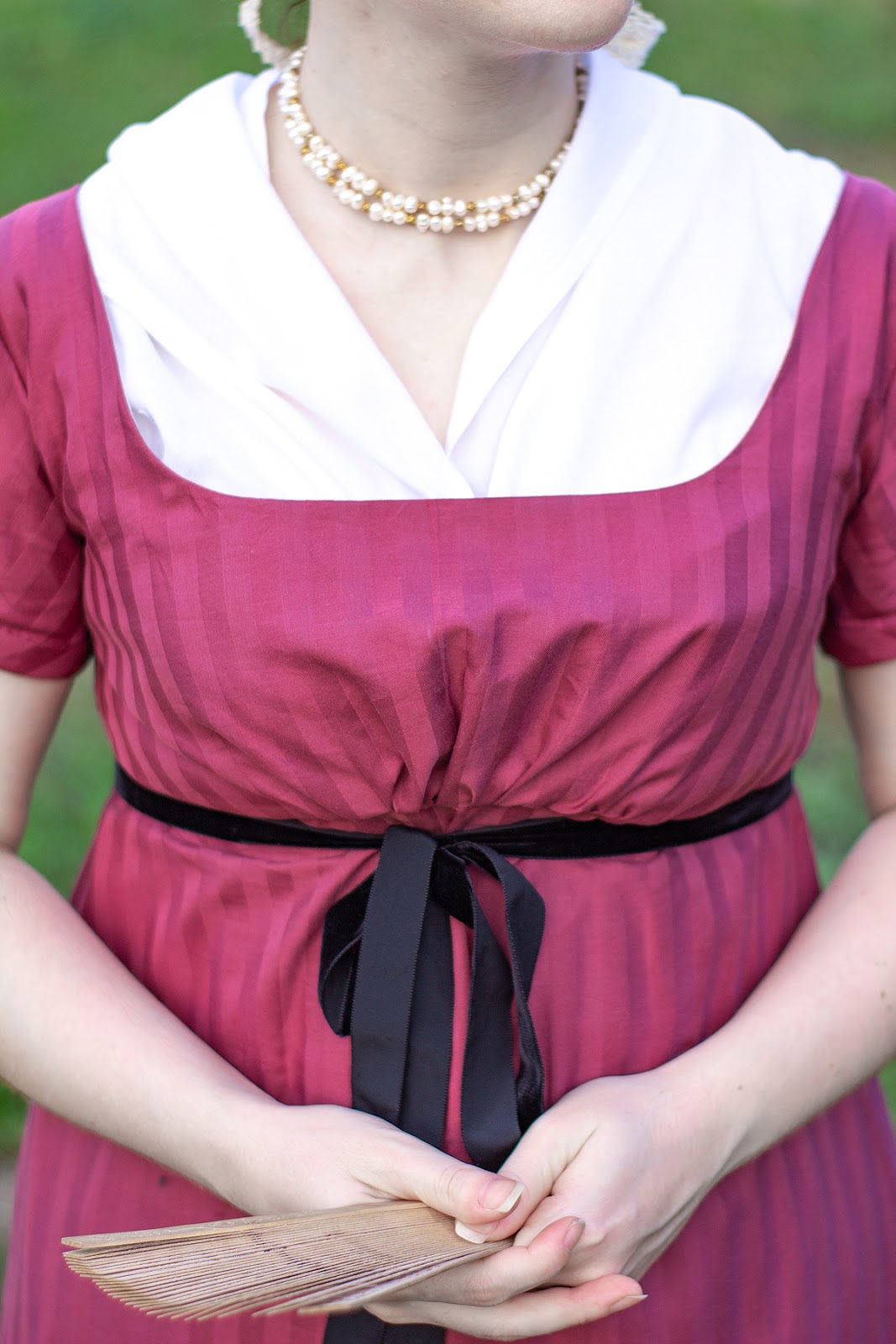
Than my boyfriend decided to take me to the fabric store three days before the event. He wanted me to go because I needed that break away from home (and he was right). At first I refused; I was out of time to make a dress (I had to leave on Saturday morning and we were on Wednesday...) and had no ideas about. Then I walked into the fabric store and found this. The perfect fabric. Striped cotton sateen in burgundy. I  made a quick research on Google and Pinterest and found an extant dress at MFA Boston. It is more 1815 but our event was set in 1810s so it would have been perfect!

And so Boston was going to be made...


I had everything: a pattern, plain cotton for lining, buttons for the back closure, thread in matching colour and a lovely black velvet belt. I immediately pre-washed the fabric and luckily it dried quickly. The bodice was cut and assembled the same day, skirt and sleeves the day after so that I had the dress finished on Friday. I still ask myself how I did...but I did! And it was a success. Trust me, I never got so many compliments like on this gown! 
I altered a little the design of the dress to fit my pattern and I used buttons instead drawstring as fastening. There was no time at all to draft another model. The original dress has also detachable sleeves but unfortunately I don't have enough fabric to make them. 

And now the photos...


The original dress on the left


A success. The colour of my fabric is really vibrant and bright as shown in the photos, the stripes are of the same width of the original dress and so the sleeves. As told before I had to change some small details like omitting the piping and the ribbon at the back, but it's not a big issue. 
I got so many beautiful pics at the event, not like last year (when I was wearing an anonymous brown caraco some of you may remember - now sold). I'm so happy with this outfit I decided to offer copies of it on my Etsy shop

Other photos of the real Boston.... 

The detachable sash...

...and the detachable sleeves! 


1770s red cotton jacket and skirt for Fulda, Germany

An outfit made some months ago for an important event in Eichenzell, Fulda, Germany! Me and my group Le vie del tempo attended the famous "Zeitreise ins 18. Jahrundert" last August and I needed a new outfit for the occasion. I didn't want an elegant dress since we had to move around the camp (a partial mistake, many ladies had elegant and luscious silk dresses!) so I decided to make a skirt and a simple jacket.


I had some yards of red cotton in my stash which were enough to make skirt and jacket (approx 3 mt in total). The yardage for the jacket was less but I managed to cut out the pieces easily. The jacket is lined in cotton, skirts included, is  not boned and closes at front with cotton lacing. The stomacher is pinned to the stays as usual.As you can see in the following photos, the jacket as no waist seam. 


Since we had to live at the camp for three days, I also made an apron to protect my skirt from dust, ashes and grass. So glad I did it! The apron was partially stained the second morning by my foundation...nothing a little bit of bleach cannot remove but imagine if this stain was on the skirt! Eeek! The fabric is lightweight white cotton also from stash and with a cotton tape in the upper edge.


Detail of stitching

The skirt is made in the accurate 18th century way, using two rectangles of fabric shaped at the waist measuring over hips pads at the back and folding the excess inwards at front. Of course it has slits at sides to reach my hanging pockets. It is pleated at front and back.


The whole thing took just a couple of days to make! Unfortunately I didn't manage to make a linen jacket for the cooler weather in the evening (time is always against me) but I'm pretty much happy with this one. It was really hepful with the very hot weather we had over there in Germany (more than 30°!)
I wanted to add some cotton sleeve tuckers to make it richer but I decided to leave it as it is - sometimes less is better.  Now I just have to add a pair of mittens and a better hat to complete my new colonial outfit. 

Post in evidenza

Edwardian skirt and blouse, circa 1900-1905

I've always been fascinated by the style of early Edwardian era, with those lightweight blouses, fabrics, delicate laces and floating s...